

A customer has just reported a lactose intolerance. The pastry chef opens the fridge, hesitates. The reflex is to look for a substitute. That’s the wrong question. The right one is to understand what the milk was technically doing in the recipe, before deciding how to replace it.
Lactose-free in professional pastry is not a concession. It is not a downgraded version of a classic recipe, nor a niche for allergic customers. It is a formulation requirement that demands going back to the function of every ingredient. And it has become a standard of hospitality in luxury hotels, fine dining restaurants and urban coffee shops.
In this article, we break down what milk actually does in a recipe, and how to remove it without breaking the balance. The method is rigorous, the angle is resolutely professional.
1. Lactose-free does not mean dairy-free
This is the most common confusion, and it costs dearly right from the start of the work. Many pastry chefs hear “lactose-free” and reformulate everything as plant-based. But these are two distinct technical issues.
What lactose actually is
Lactose is a sugar. More precisely a disaccharide, made of one glucose molecule bonded to one galactose molecule. It is poorly soluble in water, and its sweetening power is 0.15 points. That’s roughly seven times less sweet than sucrose. It’s so little that it’s generally not counted in a recipe’s sweetness points calculation.
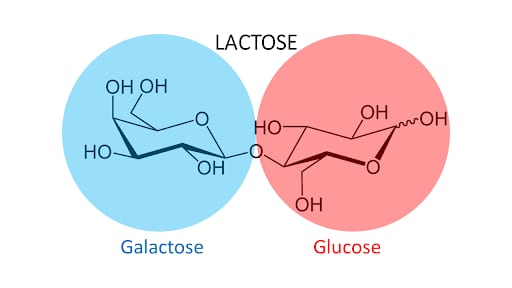
Concretely, removing lactose does not mean removing milk. It means removing a single component of milk, while keeping the others when technically desirable: proteins, fat, minerals.
Not all dairy products contain the same amount of lactose
Not all dairy products contain the same quantity of lactose. This information is rarely taught, but it changes everything:
- Clarified butter and ghee: almost lactose-free. The aqueous phase, where lactose concentrates, is removed during clarification. Perfectly tolerated by most intolerant customers.
- Long-aged cheeses (parmesan, aged comté, beaufort, aged mimolette): trace amounts or no measurable lactose, since prolonged fermentation fully degrades it.
- Fermented dairy products (yogurt, kefir, fresh cheese): fermentation converts part of the lactose into lactic acid. Fermented products contain roughly half as much as non-fermented ones.
- Lactose-free milk and cream: regular milk with added lactase, the enzyme that hydrolyzes lactose into glucose and galactose. The product keeps its structure, flavor and all its technical functions.
Before going for a full plant-based reformulation, check whether a “lactose-free dairy” path is viable. This way you keep milk’s native technical functions and its original flavor. It’s often the most rigorous path for luxury hotels and restaurants, where customer perception clearly distinguishes “lactose-free” from “dairy-free”.
2. The three technical functions of milk to rebuild
If you decide to remove dairy products entirely, you’re not just losing a “liquid base”. You’re losing three specific technical functions, and each one must be rebuilt if you want to keep the recipe balanced.
Function 1: texturizing through proteins
Milk proteins, mainly caseins and whey proteins, structure many classic preparations through coagulation and thermal gelation. Flans, crème anglaise, custards, ice cream bases: it’s their protein network that makes the mass “set” during cooking.
If you replace milk with water in a crème anglaise, the texture won’t form. That’s not a flavor problem, it’s a structural one.
Function 2: emulsion through caseins
Caseins are also natural emulsifiers. They stabilize the water-fat interface in ganaches, namelakas, creamy textures and emulsified preparations. When you replace cream with water in a ganache, the emulsion breaks, unless you add another emulsifying agent.
Function 3: flexibility through dairy fat
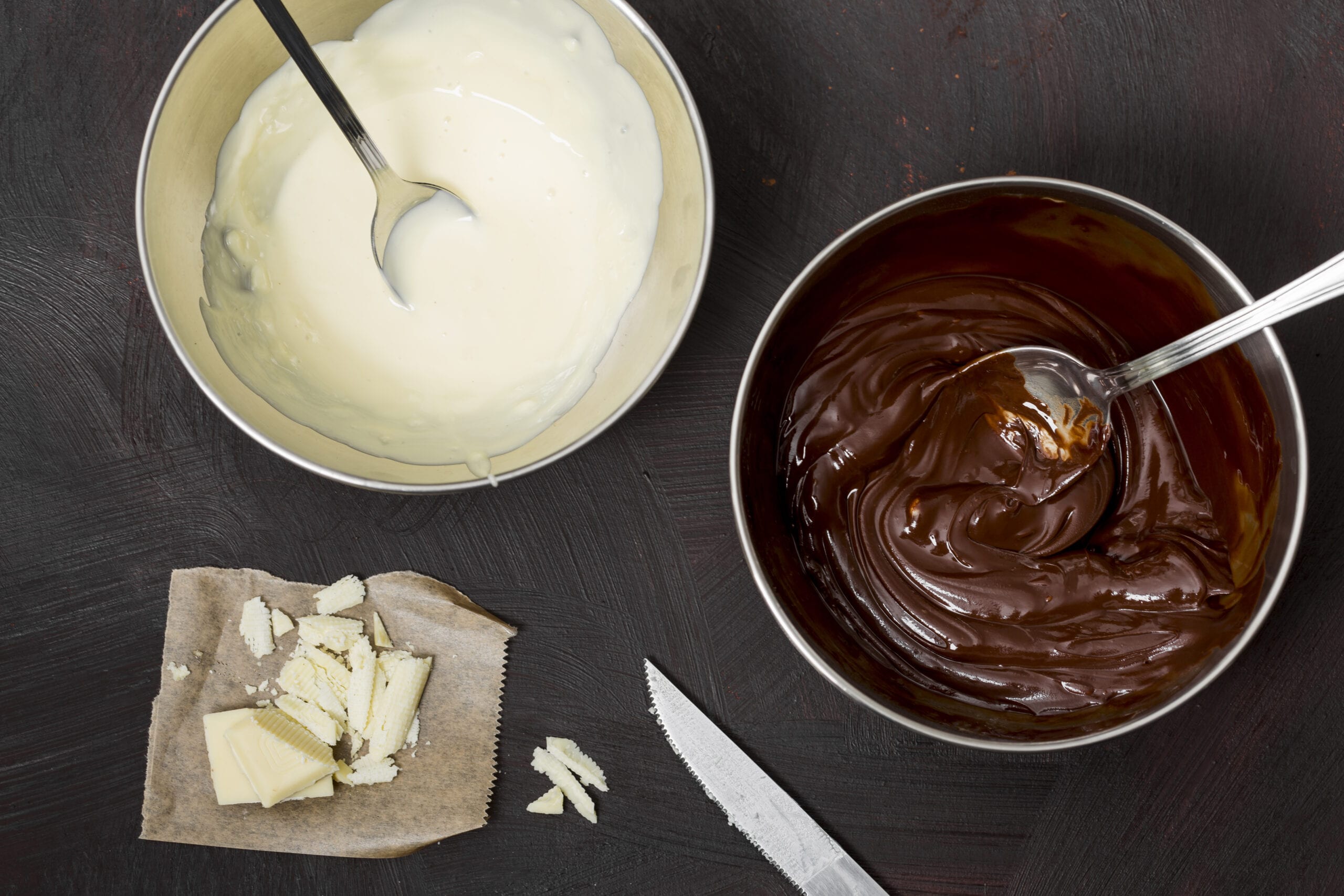
This is the most underestimated function, and the one that causes the most problems in practice. Milk fat slows down or prevents the complete crystallization of saturated fats, particularly cocoa butter.
Concretely, in a classic ganache, the mix of dairy fats gives cocoa butter a certain flexibility, keeping it from crystallizing fully. If you remove the cream without recomposing anything, the cocoa butter crystallizes completely and your ganache goes from a soft texture to a hard, brittle block.
35% fat liquid cream
- Water: 58%
- Dry extract: 42%
- Fat: 35% (including 24.6% saturated fatty acids)
- Protein: 2.1%
- Carbohydrates (lactose): 2.9%
- pH: 6.6 to 6.8
Bonus: the contribution of dry extract
Cream contributes 42% dry extract to a recipe. That’s a considerable share of the final stability, particularly in creamy textures, mousses and ganaches. Removing cream without compensating for this contribution creates a structural gap that shows up as a texture that “weeps” (syneresis), reduced stability when frozen, or a dessert that doesn’t hold well on the plate.
3. The two rigorous reformulation paths
Once these functions are identified, two reformulation strategies are possible. The choice depends on the target, the positioning and the project’s constraints.
Path A: keep the dairy product, remove the lactose
The pastry chef uses dairy products that are naturally or industrially lactose-free. Technical functions are fully preserved, and so is the original flavor.
- Clarified butter or ghee for shortbread, financiers, madeleines, puff pastry.
- Lactose-free creams (Elle & Vire Professionnel offers a dedicated range) for ganaches, creamy textures, ice cream.
- Lactose-free milk for crème anglaise, custards, flans.
- Long-aged cheeses in sweet-savory desserts and certain special preparations.
This path is particularly suited to luxury hospitality and fine dining, where customers are sensitive to the dairy aromatic profile and where “lactose-free” perception is compatible with a non-vegan menu.
Path B: plant-based reformulation and function reconstruction
The pastry chef removes all dairy products and rebuilds each function one by one with plant-based raw materials. This is the most technically demanding path, and the best suited to coffee shops, vegan-compatible offers, religious constraints (halal, kosher) and an international clientele.
The logic is always the same: identify the lost function and choose the plant-based raw material capable of restoring it.
| Lost function | Plant-based solution | Application |
|---|---|---|
| Emulsion via caseins | Citrus fiber, sunflower lecithin, nut/seed purées | Ganaches, creamy textures |
| Flexibility from dairy fat | Deodorized sunflower oil (adjusted %) | Cocoa butter ganaches |
| Texturizing via proteins | Gelling agents (gelatin, pectin, agar) or thickeners (carob gum) | Flans, custards, creamy textures |
| Dry extract and stability | Increased gelling agents, added fiber, adjusted sugars | All textures |
| Dairy flavor | Coconut cream (30-35% fat), nut/seed butters, infusions | Recipes where dairy is central |
Worth noting: for a dairy-free ganache, the approach is to introduce sunflower oil to recover the lost flexibility. If you don’t want to substitute dairy fat with another fat, the alternative is to use a gelling agent or thickener (gelatin, pectin) to rebuild creaminess through texture instead.
The logic of molecular balancing (water, fat, dry extract, sweetening power) is complex to maintain manually across an entire menu. That’s precisely why I designed ChefBase, a formulation software that integrates scientific balancing calculations (DM, MG, PS, AW) and a block-based reformulation module. Particularly useful when reformulating several recipes in parallel.
4. Technical pitfalls to anticipate
This is where the difference between amateur work and professional reformulation shows. Four recurring pitfalls deserve particular attention.
Pitfall 1: casein’s isoelectric point
Casein precipitates at pH 4.6. That’s its isoelectric point. Concretely, if you’re working with white chocolate, mascarpone or cream cheese (pH 4.4 to 4.9) alongside citrus, an acidic fruit or a red fruit purée, the casein can coagulate and compromise the emulsion. The result shows up as a grainy texture or separation.
If your lactose-free version still contains a dairy protein (lactose-free yogurt, aged fresh cheese), this risk persists. Test systematically before validating.
Pitfall 2: dairy calcium and LM pectins
Low methoxyl (LM) pectins gel in the presence of calcium. Dairy products naturally contain calcium, and LM pectins often already contain some in their formulation. If you reduce the milk in a recipe using these pectins, total calcium drops and gelation may be insufficient. Conversely, if you keep the milk without adjusting the pectin dosage, you sometimes get a gel that’s too firm.
Pitfall 3: plant proteins and galactomannans
When an emulsion contains more than 4% protein along with galactomannans (carob gum, guar gum) or xanthan gum, water-oil phase separation can occur. If you replace cream with soy cream (protein-rich) while keeping the carob gum from your original recipe, the emulsion can break. The fix: add a carrageenan to stabilize the system.
Pitfall 4: dairy flavor is not neutral
This is a perception pitfall, but it’s a real one. Dairy flavor isn’t simply a “taste blank”: it’s an aromatic signature. A vanilla ice cream without cream doesn’t just “lack fat”, it lacks a characteristic dairy note. Salted butter caramel without butter no longer has the same profile. When reformulating, anticipate this aromatic loss and work on the replacement profile (coconut milk, infused almond milk, lactose-free butter with a preserved dairy note).
Conclusion: a skill that goes back to the fundamentals
Lactose-free in professional pastry isn’t a separate skill. It’s proof of mastering the fundamentals. Whoever understands what milk really does in a recipe, across its three technical functions, knows exactly what to do when it needs to be removed. The logic is universal: it applies to gluten, to eggs, to refined sugar.
In luxury hotels, fine dining restaurants and urban coffee shops, the lactose-free offering has moved from a marginal expectation to a standard of hospitality. Customers no longer ask for a “version” but for an option at the same level. And the gap between establishments that master this reformulation and those that improvise shows immediately, both on the counter and in the customer’s verdict.
Path A (lactose-free dairy) and Path B (plant-based reformulation) are not mutually exclusive. They correspond to different projects, contexts and specifications. It’s up to each establishment to position its offer accordingly.
Reformulating your menu or your lactose-free offer?
Menu audit, reformulation support, team training on alternative pastry techniques. T.A. Consulting supports hotels, restaurants, coffee shops and culinary schools in France and internationally.
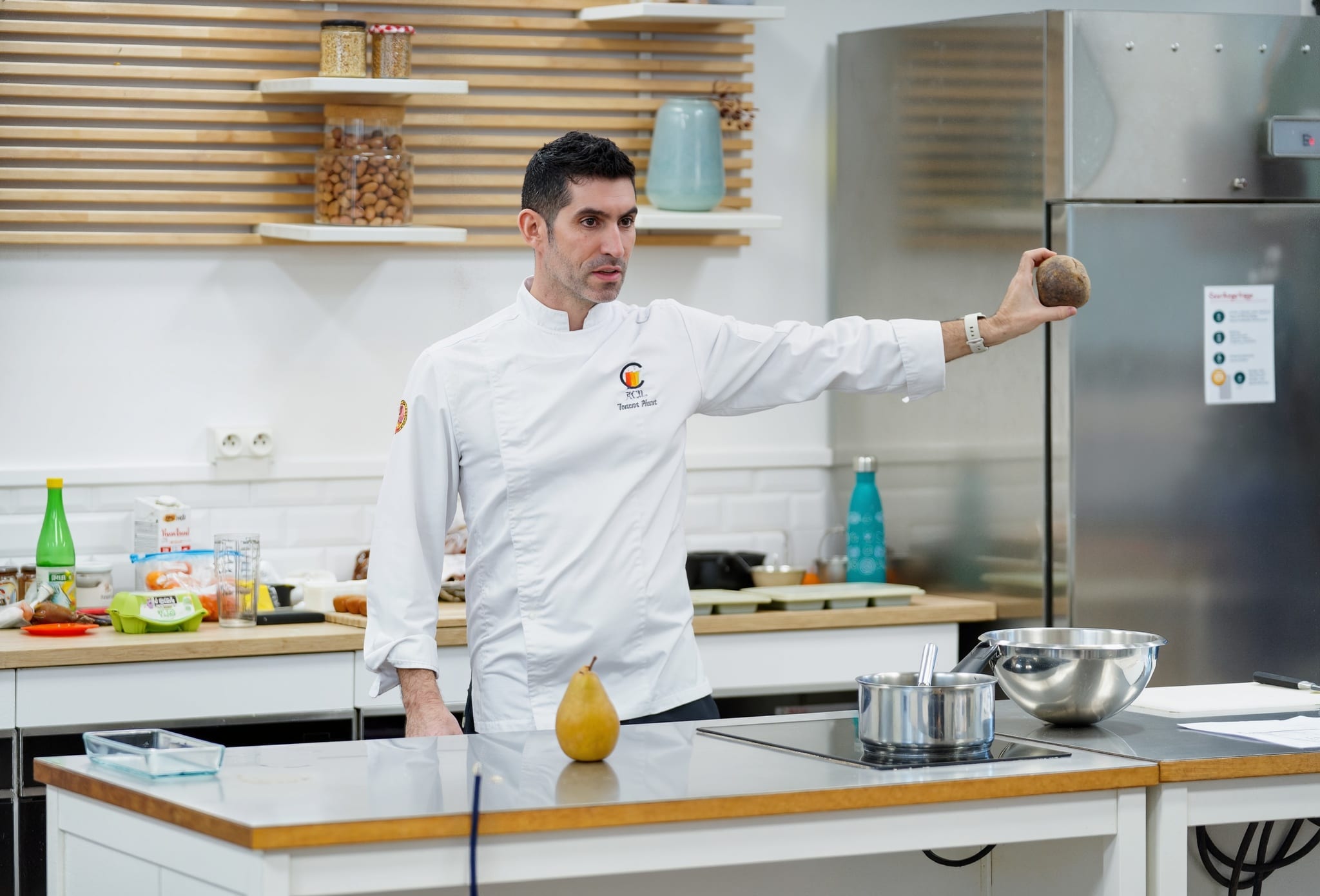 Thomas Albert is a consultant pastry chef and trainer, specialized in alternative formulations (vegan, gluten-free, lactose-free, low-GI) and high-end pastry. He works with prestigious culinary institutions (Le Cordon Bleu, École Ducasse, Culinary Art Academy Switzerland) and international hotel groups. More information at thomasalbert.fr.
Technical references: Elle & Vire Professionnel technical data sheets, USDA Food Data Central.

