

In late 2023, a TikTok video filmed in a small Dubai chocolate shop set off one of the most profitable and most distorted trends in recent pastry history. Two and a half years later, the product is no longer a viral curiosity: it’s a case study in formulation, raw material pricing, and how a professional can, or cannot, capitalize on a trend without losing credibility.
- Under the name “Dubai chocolate” coexist two radically opposed raw material cost realities: 3 to 6 €/kg for a flavored paste dosed at 6% pistachio, versus 120 to 180 €/kg for a pure Sicily Bronte PDO paste.
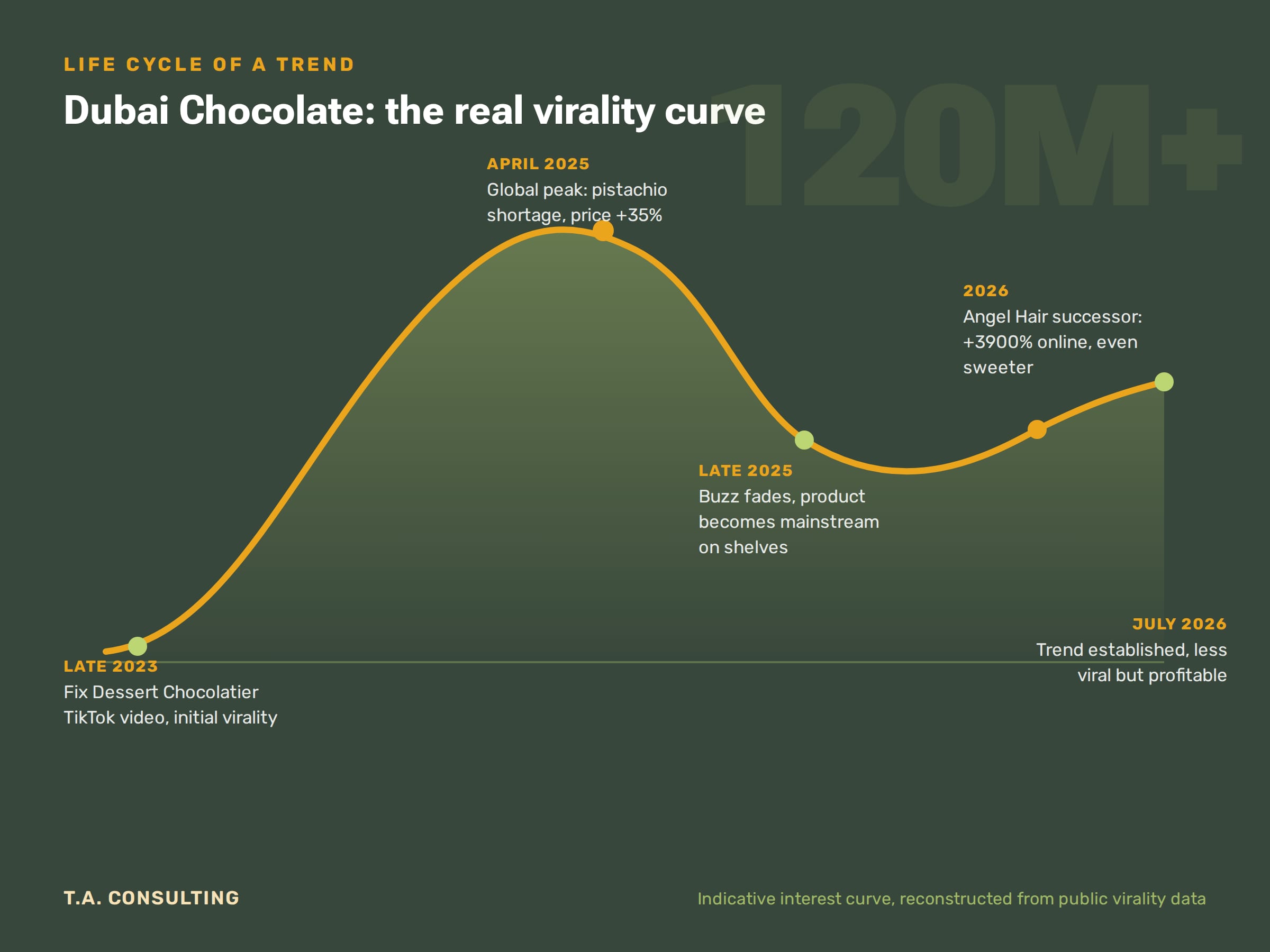
- Raw pistachio prices have risen 35% since the trend began, driven by both global demand and a frost that destroyed 70% of the Turkish harvest in 2025.
- The viral peak has passed, but the trend has mutated: the Angel Hair successor (white chocolate, Turkish cotton candy, pistachio) shows +3900% growth online, and is even sweeter.
- Three countries (the United States, Iran, Turkey) account for 90% of global pistachio production, making the supply chain highly vulnerable to climate events.
- Riding a trend intelligently means treating ingredient transparency as a commercial argument, not a technical footnote.
Where does Dubai chocolate come from, and why did it explode like this?
The product was born in 2021 at Fix Dessert Chocolatier, founded by Anglo-Egyptian entrepreneur Sarah Hamouda. Her creation, a milk chocolate bar filled with pistachio cream and kadaif (crispy angel hair pastry inspired by Levantine knafeh), stayed niche until late 2023.
A tasting video posted on TikTok changed everything: over 120 million views, a scarcity effect fueled by lines outside the Dubai shop, and a viral mechanism entirely built on sensory contrast (the crunch of the kadaif giving way to a creamy filling) filmed in close-up. This kind of content works because it checks every box of food virality: a single bite, a sound, a texture, packaging perceived as luxurious. Major brands took notice: Lindt released its own version in early 2025, followed by dozens of chocolatiers and manufacturers worldwide.
One viral product, two radically different qualities: where is the line?
This is the most misunderstood aspect of the trend. Under the label “Dubai chocolate” coexist two formulation realities that have almost nothing in common, and the gap shows up first in raw material cost.
| Criteria | Degraded product | Quality product |
|---|---|---|
| Raw material cost | 3 to 6 €/kg | 120 to 180 €/kg (pure Bronte paste) |
| Pistachio dosage | 6% of the mass | 100% pure pistachio |
| Composition | Sugar, water, flavoring listed first | No additives, traced origin |
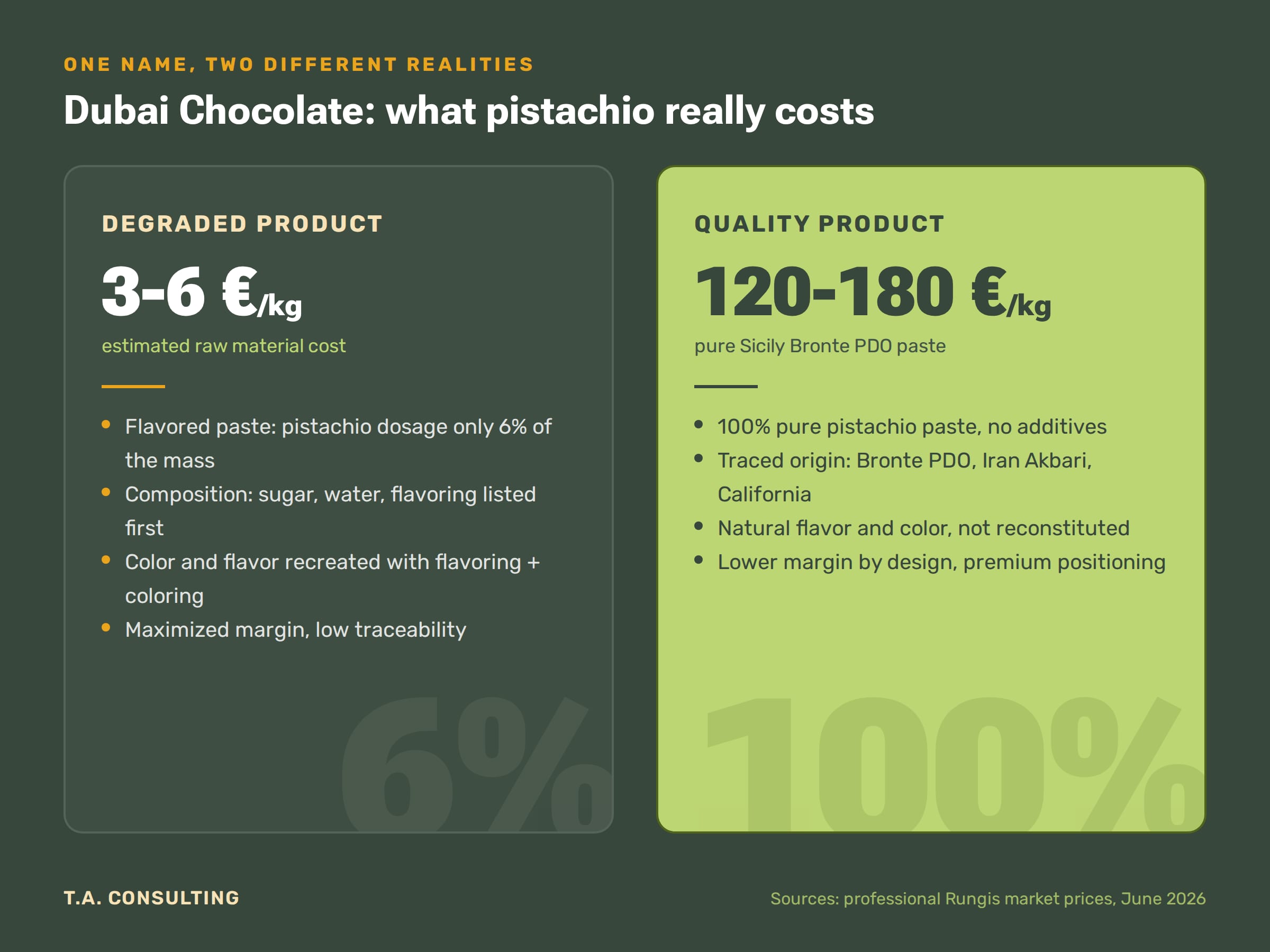
Between these two extremes, the consumer often sees only the packaging and the name. This is precisely where differentiation happens: an establishment that owns its real raw material cost versus an offer that trades on image without substance.
What’s left of the trend in July 2026?
The peak intensity has passed. After the explosion in demand and the pistachio shortage in the first half of 2025, the product has become mainstream: it is now found on supermarket shelves, in wildly uneven versions, without the scarcity effect that drove its initial success.
But the trend isn’t dying, it’s mutating. Its most talked-about successor, the “Angel Hair” bar (white chocolate, melting Turkish cotton candy, pistachio cream, notes of vanilla and pomegranate), shows online growth of 3900% over the recent period. The verdict is clear: this is absolutely not a shift toward health. The market is moving toward more sugar, not less, with white chocolate and cotton candy as the new star ingredients.
What has disappeared
The initial scarcity effect, the lines outside the shop, and part of the media attention, now turned toward other formats (filled bars, matcha and hojicha lattes, cross-cultural flavors).
What has stuck around for good
Kadaif and pistachio cream as a recognized texture combination, and a pistachio market structurally reshaped by two years of price pressure. This phase also reveals a clear split between two schools: on one side, houses that raise the standard (real traceability, pure paste, a price consistent with actual raw material cost), on the other, generic production that lowers it (minimal real pistachio content, flavoring and sugar as substitutes, a slashed price that reflects nothing of the raw material’s real scarcity).
Wondering how to turn a viral trend into a lasting part of your offering, without diluting your brand? Let’s talk about your specific case.
What structural change has this trend produced in the industry?
Three lasting effects stand out, beyond the product itself.
- Social media has become a full-fledged product discovery channel, capable of creating global demand within weeks, outside any traditional marketing cycle.
- Customer expectations are now shaped by viral aesthetics: a product that doesn’t “film” well starts at a commercial disadvantage, regardless of its actual taste quality.
- Pressure on raw material costs has spread across the entire nut supply chain, not just Dubai chocolate, forcing professionals to revisit margins on every pistachio-based recipe.
How should a professional ride a trend without doing the same thing as everyone else?
The most common temptation is to copy the most visible version, often the least qualitative one, because it appears the most profitable in the short term. Three reflexes help avoid this trap.
- Anticipate rather than react. A viral trend can be spotted within its first six months. Beyond that window, the room for differentiation narrows down to quality and transparency, rarely to having arrived first.
- Make ingredient transparency a commercial argument. Stating the origin and the real pistachio percentage on a product sheet or menu isn’t a technical detail: it’s what separates an offer built to last from one that simply follows fashion.
- Index the selling price on the real raw material cost, not on the hype. Selling a low-pistachio version at the price of a quality one works for a while, until professional or knowledgeable customers notice the difference.
What is the impact of the pistachio price surge on the entire market?
The pressure isn’t limited to Dubai chocolate: it has reshaped the global pistachio economy. The price of raw pistachio has risen 35% since the trend began, going from $7.65 to over $10.30 per pound according to the Financial Times. This increase stems from the combination of sudden demand and an already fragile supply: a frost destroyed 70% of the Turkish harvest in 2025, while the United States, Iran and Turkey alone account for 90% of global production.
Facing this pressure, growers in California and now Provence are uprooting almond orchards to plant pistachio trees, a bet on demand they judge durable. But a pistachio tree takes five years to bear its first fruit: no structural relief is expected for several years. Market research firms project global pistachio market growth of over 30% over ten years, reaching nearly $6 billion in the 2030s. For any establishment working with pistachio, this supply pressure has become a management parameter in its own right, not just a side effect of a passing fad.
Want to turn a viral trend into a lasting differentiator?
Menu audit, product positioning, ingredient transparency and team training on alternative pastry formulation. T.A. Consulting supports luxury hotels, fine dining restaurants, coffee shops and culinary schools in France and internationally.
Related articles
Frequently asked questions about Dubai chocolate
Thomas Albert is a consultant pastry chef and trainer, specialized in high-end pastry and alternative formulations (vegan, gluten-free, lactose-free, low-GI). He works with prestigious culinary institutions (Le Cordon Bleu, École Ducasse, Culinary Art Academy Switzerland, La Folie Douce) and international hotel groups. Founder of ChefBase, the all-in-one software for pastry professionals. More information at thomasalbert.fr.
Sources: Financial Times. Wikipedia, Dubai chocolate article. Puratos Taste Tomorrow, 2026 chocolate trends. Rungis/Foodomarket professional market prices, June 2026. France 3 Régions PACA, October 2025. Euronews, March 2026.

