


A pastry chef announces a low glycemic dessert because the sponge uses almond flour. The mirror glaze, however, is still made with inverted sugar syrup. The finished dessert is nothing close to low GI: an entremets does not have one GI, it has several that combine according to the share of carbohydrates each component contributes. Knowing how to calculate that overall figure, and knowing which component to work on to bring it down, is what separates marketing language from a genuinely documented formulation.
Key takeaways
- The GI of a single ingredient does not tell you the glycemic impact of a multi-component dessert.
- The overall GI is calculated as a weighted average based on each component’s carbohydrate contribution, never a simple arithmetic average.
- In a classic entremets, the glaze and the fruit insert often weigh more heavily on the final result than the base.
- Reducing the overall GI means targeting the component that contributes the most carbohydrates, not reformulating everything uniformly.
- The resulting figure remains a formulation estimate, not a laboratory-measured value or medical data.
Why doesn’t the GI of a single ingredient reflect the real impact of an entremets?
What the glycemic index measures, and what it doesn’t
The glycemic index compares the glycemic response of a food eaten alone to that of pure glucose (GI 100). It is measured in a laboratory on a standardized 50 g carbohydrate portion. It is ingredient data, not recipe data. A professional entremets is never a single ingredient: it is a stack of components (sponge, insert, mousse, glaze) whose proportions and individual GI values vary widely.
The specific problem of multi-component desserts
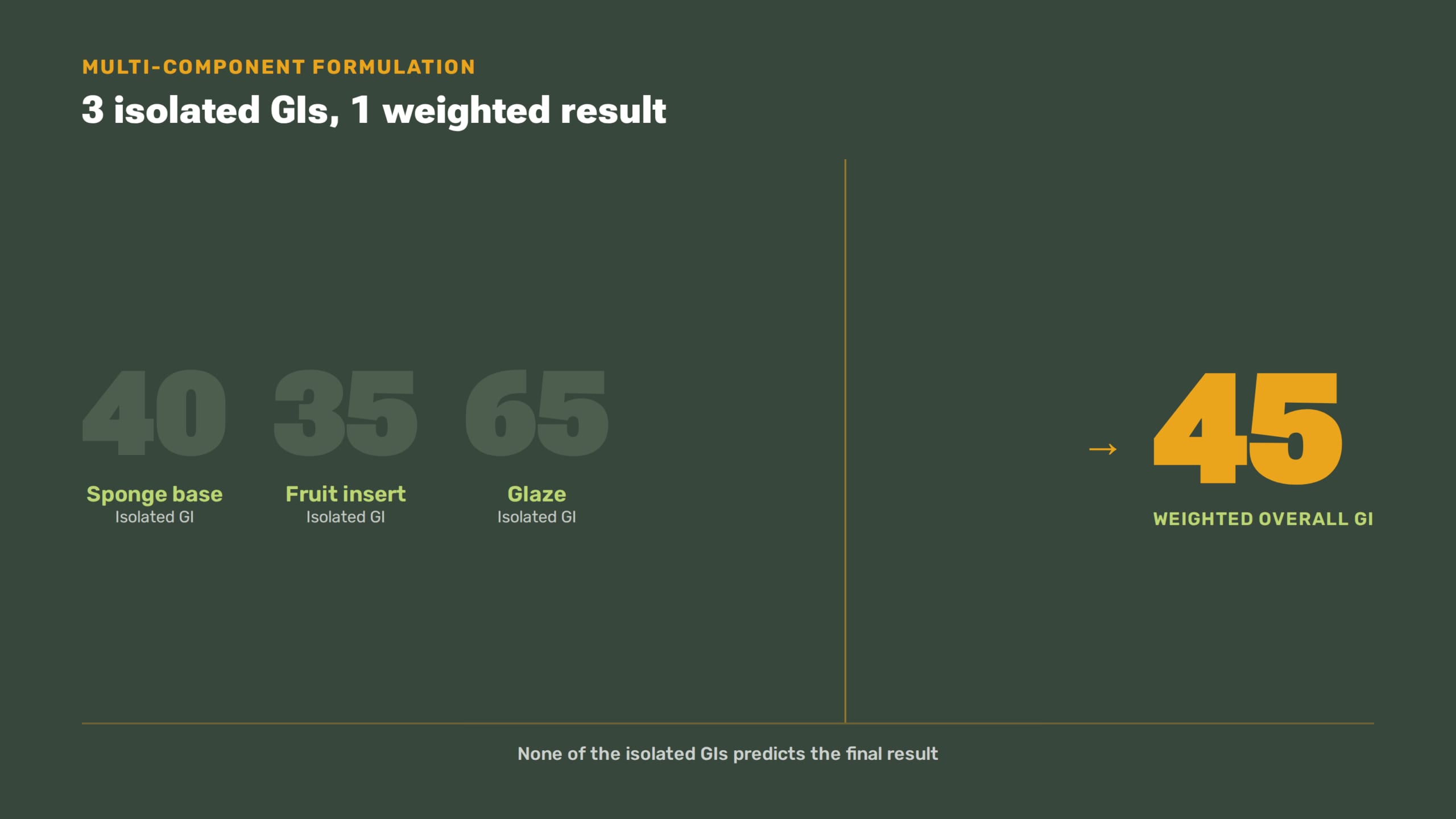
Averaging the GI values of each component arithmetically gives a false result. A mirror glaze that represents 10% of the total weight but 25% of the dessert’s carbohydrates weighs more heavily on the result than a base that represents 40% of the weight but contributes few assimilable carbohydrates (an almond flour base, for example). The question is not “what is the GI of each element” but “what share of carbohydrates does each element contribute to the total, and at what GI”.
How do you calculate the overall GI of a pastry made of several components?
The method recognized in nutrition (used notably for mixed meals) is the weighted average based on the assimilable carbohydrate content of each component.
Formula
Overall GI = Sum (assimilable carbs of component × GI of component) / Sum (total assimilable carbs)
In practice, the method follows four steps:
- Break down the recipe into its distinct components (base, insert, filling, glaze, decoration).
- Calculate the assimilable carbohydrates of each component for the portion actually served, based on ingredient technical sheets (total carbohydrates minus fiber).
- Assign a GI to each component, using reference tables (University of Sydney Glycemic Index Research Service as a priority source) or by matching it to the component’s dominant ingredient.
- Weight and sum according to the formula above to obtain the overall GI of the portion.
Key point: the weight of a component is never the basis for weighting. Only the share of assimilable carbohydrates it contributes matters. A component can represent 35% of a dessert’s mass and only 20% of its carbohydrates (the case of a fat-rich mousse): it is that 20% that multiplies its GI in the calculation, never the 35% of mass. Weighting by weight would understate the real impact of components that are minority by mass but majority by carbohydrates (glazes, coulis, fruit inserts).
A complete worked example: a four-component entremets
Consider a 100 g entremets made of an almond sponge base, a raspberry insert, a 70% dark chocolate mousse and a mirror glaze. The values below are formulation orders of magnitude, to be validated against actual supplier technical sheets.
| Component | Weight (g / %) | Carbs (g / %) | Estimated GI | Contribution |
|---|---|---|---|---|
| Almond sponge base | 25 g (25%) | 6 g (16%) | 40 | 240 |
| Raspberry insert | 20 g (20%) | 9 g (24%) | 35 | 315 |
| 70% dark chocolate mousse | 35 g (35%) | 8 g (22%) | 25 | 200 |
| Mirror glaze | 20 g (20%) | 14 g (38%) | 65 | 910 |
| Total | 100 g (100%) | 37 g (100%) | – | 1665 |
Overall GI = 1665 / 37 = 45. The table highlights the gap between mass and carbohydrates: the chocolate mousse is the heaviest component (35% of mass) but contributes only 22% of the carbohydrates, while the glaze, a minority by mass (20%), concentrates 38% of the carbohydrate load. This gap is exactly why weighting must be done by carbohydrates, never by weight: the glaze is therefore the first lever to work on, not the mousse.

Which levers can reduce the overall GI without altering the product?
Target the highest-contributing component
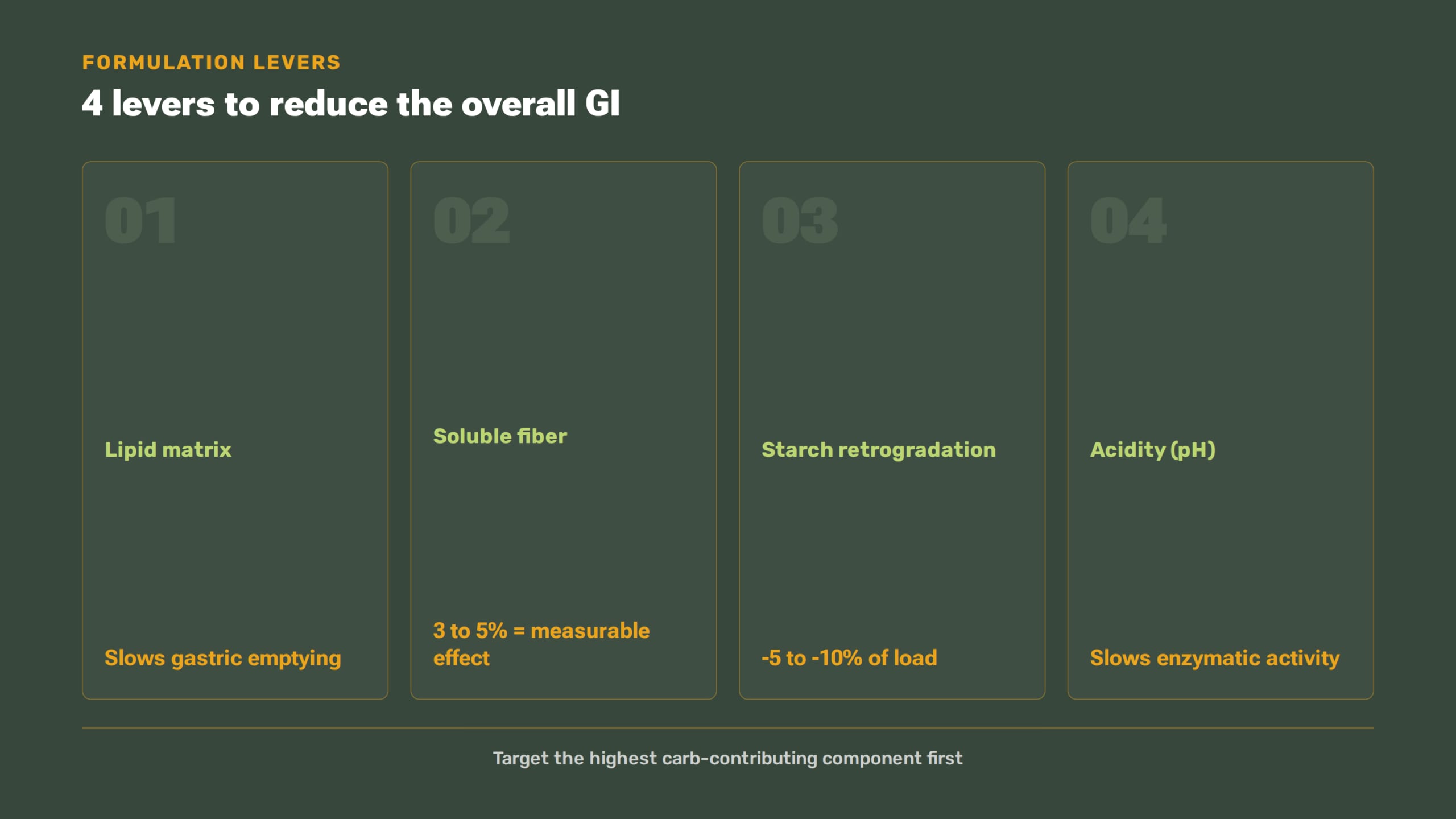
The example above makes it clear: reformulating all four components uniformly is inefficient. Identifying the component that weighs most heavily in the weighted contribution, here the glaze, and reworking it first (partially replacing inverted sugar with a polyol such as xylitol or isomalt) lowers the overall GI far faster than a full reformulation.
Strengthen the lipid matrix and soluble fiber
A component rich in fat (dark chocolate mousse, nut-based preparations) slows gastric emptying and moderates the glycemic response of the whole dessert, including neighboring components eaten in the same bite. Soluble fiber (psyllium, inulin, pectins) added at 3 to 5% in a high-GI component produces a measurable effect on the post-prandial curve.
Use starch retrogradation
For starch-based components (sponge, dough), chilling below 4°C for at least 12 hours before service converts part of the starch into type 3 resistant starch, which is no longer digested as an assimilable carbohydrate. The gain is roughly 5 to 10% on the glycemic load of that component, useful for travel cakes or productions made ahead of time.
Does the method change depending on the type of pastry?
The weighting principle stays the same, but the number of components and their relative weight vary. A four or five-layer entremets requires a full calculation like the one above. A tart (dough, filling, topping) usually has fewer components, but the dough, often made with white flour, weighs more heavily. A dry biscuit or a single-component pastry is treated as a simple GI calculation, with no weighting needed, which often makes it the easiest format to position as low GI.
What methodological limits should you know before communicating a figure?
This calculation remains a formulation estimate built from reference GI values per ingredient, not a clinical measurement of the finished recipe. Published GI values vary depending on the study, ingredient variety and manufacturing process. Before any commercial claim (“low GI”, “formulated to limit glycemic impact”), it is necessary to check the figure’s consistency with the regulatory framework for nutrition claims, and never present this calculation as a substitute for individual medical or dietary advice.
To go further on low-GI formulation and the regulatory framework for claims, our article on pastry for people with diabetes details the glycemic load method per portion. On composition levers, see also our articles on functional fibers and on reducing sugar in professional pastry.
Frequently asked questions about calculating overall GI
It is the GI resulting from a whole dessert made of several elements (base, insert, mousse, glaze), calculated as a weighted average based on the share of assimilable carbohydrates each component contributes. It differs from the GI of each ingredient taken in isolation.
For each component, multiply its assimilable carbohydrates by its GI, then divide the sum by the total assimilable carbohydrates of the dessert. The formula is: Overall GI = Sum (carbs of component x GI of component) / Sum of total carbs.
The component that contributes the largest share of assimilable carbohydrates, not necessarily the one that weighs the most in grams. In a classic entremets, the glaze or the fruit insert often contribute more than the base, even in smaller quantity.
Target first the component that contributes the most to total assimilable carbohydrates, usually the glaze or the insert, rather than reformulating all components uniformly. Partially replacing sugar with a polyol in that single component often has more impact than the rest of the recipe combined.
No. Calculating the overall GI is a professional formulation tool based on reference values per ingredient, not a clinical measurement of the finished recipe. It never substitutes for the guidance of a physician, diabetologist or dietitian.

