


You’ve probably experienced this already: a dessert advertised as “light” that still feels incredibly satisfying. Not necessarily sweeter. Just… more accurate. This isn’t magic or a sweetener trick. It’s a change of logic: gourmet pleasure is no longer driven by grams of sucrose, but by perception.
- Why reducing raw sugar isn’t enough, and what actually drives indulgence
- The 5 actionable neuro-sensory levers in professional pastry
- How top pastry chefs and food brands use this approach
- How to reformulate a dessert so it feels more indulgent with less sugar
Welcome to the era of neuro-sensory pastry: a discipline built on a simple, and highly scientific, idea. The brain tastes before the mouth does.
In luxury hotels, fine dining restaurants and urban coffee shops, demand for desserts that are less sweet but just as desirable keeps growing. The answer isn’t a substitute sweetener. It lies in understanding sensory perception and in intelligently reformulating recipes.
Sugar has four functions, and only one of them is “sweet”
Before reducing sugar in a recipe, you need to understand what it actually does. In professional pastry, sugar fulfills four distinct functions:
- Sweet taste (the most visible function, and the least important technically)
- Texture building (mass, viscosity, crispness, hold)
- Water management (water activity/Aw, softness, shelf stability)
- Aroma release (sugar binds and releases the volatile compounds that carry flavor)
Reducing sugar without a strategy is like removing a load-bearing wall. The dessert collapses in texture, stability and flavor, not because it lacks sweetness, but because all of its technical functions were destabilized at once.
If you reduce sugar, you must compensate for its functions, mass, structure, water, not just its taste. Jordi Bordas, B.Concept
Why you can cut sugar without frustrating the palate
Perceived sweetness is not a single signal sent by the taste buds. It’s a multisensory construction the brain assembles from several channels at once:
- Retro-olfaction: the aromas perceived in the mouth while tasting
- Texture: viscosity, coating, length in the mouth
- Temperature: cold reduces perceived sweetness, heat amplifies it
- Contrasts: acidity, bitterness and salt create relief and make sweetness more legible
- Vision and shape: the design of a dessert orients expectation, and therefore perception
The most powerful lever is aroma. Certain “congruent” aromatic families, vanilla, caramel, ripe fruit, dairy notes, trigger a cognitive association with sweetness in the brain. Measurable result: a dessert that is less sweet but more aromatic on these registers will be perceived as sweeter than a sweeter dessert with a neutral aromatic profile.
The 5 neuro-sensory levers in professional pastry
Here is how to activate each lever without changing your products’ identity or overloading your prep line.
Lever 1: Boost sweetness with aroma
The brain associates certain aromatic families with sweetness before sugar is even detected. In professional pastry, treating aroma as a structural ingredient, on the same level as flour or butter, allows more perceived sweetness with less sucrose.
Grant Achatz (Alinea, Chicago) popularized the idea of delivering aroma at the key moment of tasting to amplify the experience. In boutique and hotel pastry, this logic shows up in olfactory profiles heavily oriented toward vanilla, caramel or dairy notes, designed to carry the perception of sweetness without raising the glycemic load.
Lever 2: Extend the sensation in the mouth
A rounder, longer texture increases satisfaction, even with less sugar. A more viscous matrix slows salivary dilution and extends aroma release, giving the brain more time to build the sensation of pleasure.
Whipped ganaches, aerated creamy textures, coating textures built from structured fat systems, fibers and hydrocolloids: this is the path pastry chefs like Frédéric Bau have explored under the banner of “reasoned indulgence”. The key is balance, not blind addition.
Lever 3: Create intelligent contrasts
A linear dessert gets tiring fast. A dessert designed as a sequence of sensations holds attention and increases overall satisfaction. The most effective contrasts for sugar reduction:
- Crunchy / melting (the texture contrast keeps attention active and extends tasting)
- Cold / warm (plays on the thermal perception of sweetness)
- Acidic / sweet (calibrated acidity from citrus, red fruit or yogurt replaces part of the sugar load while adding relief and freshness)
Lever 4: Design the sweet attack
The brain mostly remembers two moments in a tasting: the first bite and the finish. The strategy is to concentrate a reduced but precise dose of sweetness at these two instants, rather than diluting it evenly throughout the preparation.
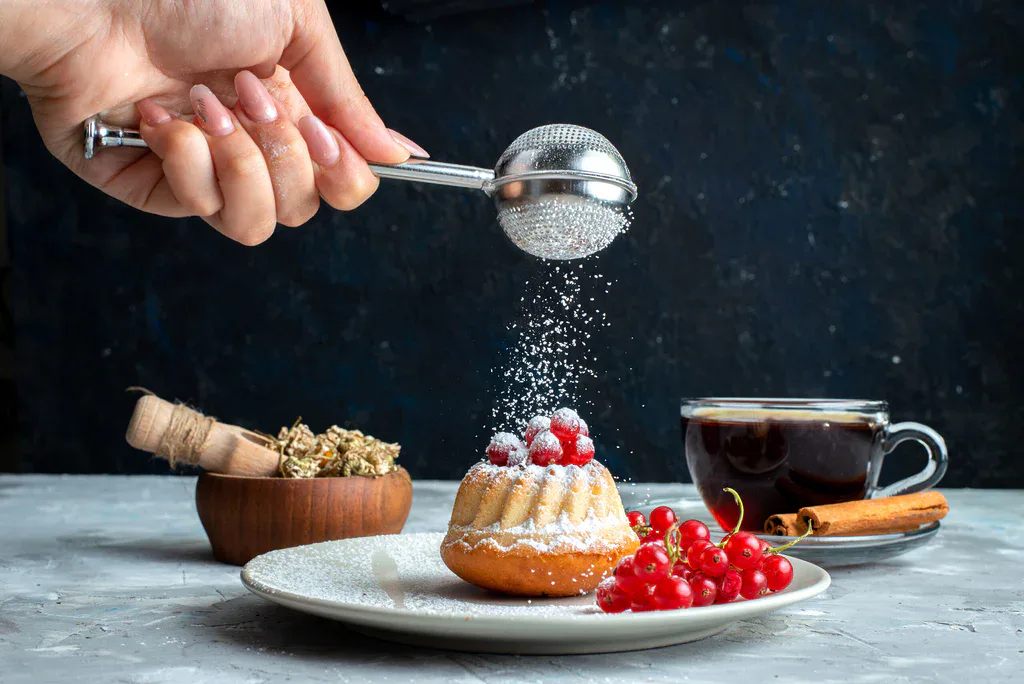
Concrete tools: a thin surface glaze, a sweet powder or spray, a fast-diffusing insert at the core of the dessert. Less sugar overall, but a sharper perception at the right moment.
Lever 5: Use design as an ingredient
Shape, color and presentation context influence flavor perception. This isn’t anecdotal: scientific work on multisensory perception (Charles Spence, Gordon Shepherd’s Neurogastronomy) documents the measurable effect of visuals on perceived sweetness.
- Rounded shapes, cognitively associated with sweetness, unlike sharp angles
- Warm colors, gold, cream, caramel, prime the expectation of sweetness before the first bite
- Storytelling and plating, a dessert that’s “well told” on the menu or beautifully plated is perceived as tastier
Heston Blumenthal illustrated this principle with his dish “Sound of the Sea”: the sound of waves played during the tasting objectively increased the perceived iodine notes of the dish. The environment is an ingredient.
What the best pastry chefs do
Jessica Préalpato (Desseralité) popularized the idea that sugar can become a seasoning: you look for the natural sweetness of the product, the season, the ripeness. You no longer impose it, you reveal it.
Jordi Bordas (B.Concept) makes a key formulation point: if you reduce sugar, you must compensate for its functions (mass, structure, water), not just its taste. Cutting sugar without a full reformulation is a failure waiting to happen.
- Reducing sugar without shifting toward ultra-processed ingredients
- Standing out through a distinct sensory signature (texture + aroma + sequence)
- Communicating “better designed” rather than “less”, a far stronger commercial message
- Meeting the expectations of an international clientele increasingly attentive to nutritional quality without compromising on pleasure
Conclusion: the pastry of tomorrow will feel better
Tomorrow’s pastry won’t be “less sweet”. It will feel better. Once you understand perception, you can reduce sugar without breaking indulgence, and even create desserts that are more modern, clearer and more desirable.
This approach puts R&D back at the center. The point isn’t to replace sugar. The point is to redesign the entire tasting experience.
In consulting missions for luxury hotels, culinary schools and food brands, T.A. Consulting supports dessert transformation: defining the sensory target, choosing ingredients and processes, test plans and prototyping. Sugar reduction, plant-based pastry, gluten-free, allergen-free, low-GI: this is exactly that scope.
Working on a reformulation or a new sweet concept?
Defining the sensory target, choosing ingredients and processes, test plans and prototyping. T.A. Consulting supports luxury hotels, fine dining restaurants, culinary schools and food brands in transforming their desserts: sugar reduction, plant-based pastry, gluten-free, allergen-free, low-GI.

References: Charles Spence, research on multisensory perception. Gordon M. Shepherd, Neurogastronomy. Research on odor-induced sweetness enhancement. Chef examples: Heston Blumenthal, Grant Achatz, Jessica Préalpato.