



A pastry chef opens the display case on Monday morning. Twenty-four references. Four seasonal additions launched in March that he never took the time to test against actual sales. Six classics that sell poorly but that he keeps “out of tradition”. He knows there is a problem, but he does not know where to start. This is exactly where streamlining becomes an act of management, not intuition.

An abundant display flatters an establishment’s image, but it is almost never an indicator of quality. The opposite is often true. The wider a menu, the longer the mise en place stretches, the more stock accumulates, the heavier the losses weigh, and the lower the precision drops. “Less but better” is not an aesthetic stance: it is an operational method built on professional management frameworks.
As a menu development consultant, I detail in this article the decision grid I use on my menu audit assignments for high-end hotels, fine-dining restaurants, urban coffee shops and pastry boutiques. Three levers, three precautions, concrete figures.
1. The data-driven diagnosis: applying menu engineering to pastry

Menu engineering has been the reference framework in foodservice since the work of Kasavana and Smith in 1982. It rests on a simple idea: every reference on a menu should be positioned on two axes, popularity (sales volume) and profitability (gross margin in currency, not in percentage). From this matrix emerge four categories, and four distinct strategies.
The four quadrants applied to pastry
| Category | Profile | Strategy |
|---|---|---|
| Stars | Sold often, high margin | Protect, showcase, never remove from the menu |
| Puzzles | Sold rarely, high margin | Reposition, communicate better, or bundle into a set menu |
| Plowhorses | Sold often, low margin | Rework food cost, price or portion to recover margin |
| Dogs | Sold rarely, low margin | Remove without hesitation |

The classic mistake is to reason in margin percentage rather than in margin in currency. A dessert showing a 75% margin on a 4 euro selling price yields 3 euros per piece. A dessert at 55% margin on a 9 euro price yields 4.95 euros per piece. The second is more profitable, despite a lower percentage margin.
A menu engineering audit is relevant every three to six months, over a window of at least four weeks of sales to smooth out seasonal variations and one-off event peaks.
The minimum data to extract from the POS for each reference:
- Number of units sold over the period
- Unit selling price
- Unit food cost (calculated from the technical sheets)
- Gross margin in currency per unit
- Total gross margin (units x unit margin)

Streamlining a menu is not decided by looking at the display case. It is decided by looking at the sales figures, the technical sheets and the production time.
2. The logic of shared technical bases
This is the most underused lever in professional pastry, and probably the one that frees up the most operational gains. The principle is simple: from a few exceptional technical bases, you can derive three to six different desserts without degrading the final quality level.
The pooling principle
A well-formulated reconstituted shortbread can serve as a tartlet base, the base of an individual entremets, a crunchy layer on a plated dessert, and the biscuit for a travel cake. A reference pastry cream can feed a Paris-Brest, a Saint-Honore, a fruit tart and a mille-feuille. A soft sponge can be turned into three different entremets simply by changing the insert, the glaze and the finish.
The marginal cost of the fourth variation tends toward zero, because the pre-preparation is already done. The cumulative mise en place time drops significantly.
Measurable gains
- Mise en place time: on an average daily production, moving from dedicated bases to shared bases typically allows a 20 to 35% reduction in total pre-preparation time.
- Quality stability: fewer variables, fewer risks of error, more consistency from one piece to the next.
- Raw material stock: concentrating on a few bases used several times reduces the rotation of secondary raw materials and the losses linked to rarely used ingredients.
- Team training: a commis who masters the base mechanically masters the six desserts derived from it. The learning curve shortens.
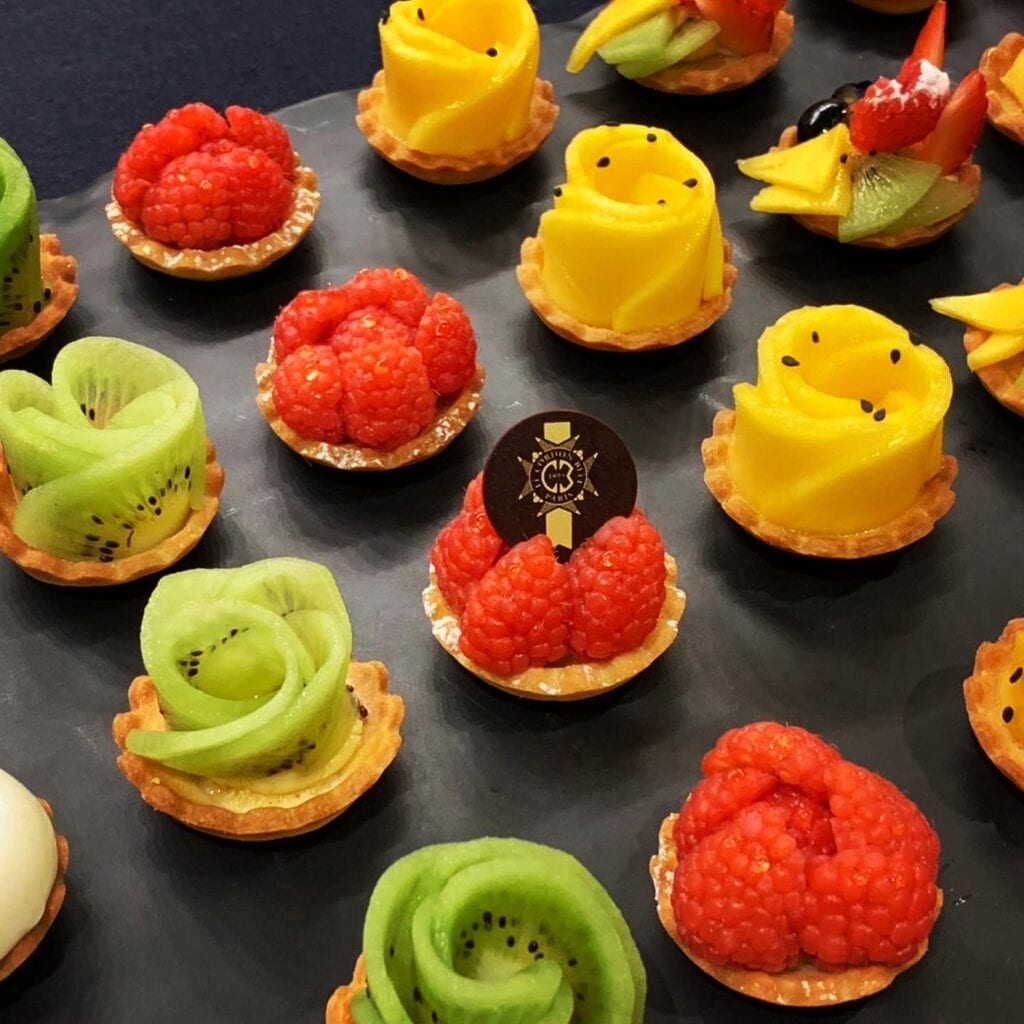
Pooling is never done at the expense of taste. It is built on bases of excellence, not on compromises pulled downward. The practical rule: a shared base must be at least as good as the best dedicated base it replaces. If it is not, then the base is not the right one.
3. Streamlining sourcing and raw material references
The menu project has its upstream counterpart, which is too often forgotten. A simplified menu sourced with fifty active raw material references remains an operational burden. The streamlining logic also applies to ingredients.
The menu engineering principle: versatile material, concentrated supplier
A raw material reference used in a single recipe is an operational risk: risk of expiry, risk of stockout affecting a single product, administrative burden for a low volume. A reference used in five recipes is an asset: rotation is high, freshness is guaranteed, and the volume justifies price negotiation.
The sourcing KPIs to track
- Number of active raw material SKUs over the last twelve months
- Average rotation per reference (number of times stock is renewed over the period)
- Capital tied up in stock to date
- Number of active suppliers and average delivery lead time
- Loss rate by category (fresh fruit, dairy products, dry ingredients)
The realistic objective in a full audit: reduce the number of raw material SKUs by 30 to 40% without touching the final quality level, by concentrating volumes on versatile references (signature couverture chocolate, exceptional butter, reference fruit purees, two or three well-chosen flours).
Concentrating volumes with fewer suppliers mechanically increases negotiating power on pricing. On the support assignments I run, the average gain on the most strategic raw materials (chocolate, butter, sugar) sits between 4 and 8% after renegotiation, which weighs directly on the gross margin.
4. The pitfalls of over-streamlining
Like any management principle, simplification has its downside. Over-streamlining exists, and it can destroy what it claims to protect. Four pitfalls to watch.
Pitfall 1: losing identity
A menu that is too short can signal a poverty of offering rather than mastery. The trade-off plays out case by case, by establishment type.
| Type | Target menu width | Underlying logic |
|---|---|---|
| Urban coffee shop | 6 to 8 references | Fast rotation, readable display, snacking |
| Pastry boutique | 10 to 14 references | Displayed diversity, seasonal signatures |
| Fine-dining restaurant | 4 to 6 desserts | Concise menu, full seasonal renewal |
| 4-5 star hospitality | 8 to 12 desserts (menu) + one-off offers | Standard, room service, events |

Pitfall 2: demotivating the team
A team that only repeats the same recipes for twelve months eventually burns out. Streamlining must preserve a space for controlled creativity. The practical rule: two to three new items per season, designed on the existing technical bases so as not to blow up the mise en place, but offering a genuine taste novelty. It is the balance between industrial stability and creative oxygen.
Pitfall 3: over-pooling to the point of erasing the signatures
If every dessert on a menu shares the same technical bases, they end up resembling one another. Consistency becomes uniformity. The countermeasure: keep two or three desserts with a unique construction, designated as signatures, which justify a dedicated mise en place through their strong commercial or symbolic positioning.
Pitfall 4: deciding on gut feeling
Simplification must rely on real figures (actual sales, calculated margins, measured production time). Not on the gut feeling of the chef de partie, nor on the habits of the pastry chef, nor on nostalgia for a classic. This is the hardest point to hold, because it forces convictions to be confronted with data. But it is precisely what separates a professional menu audit from an amateur reorganisation.
5. Equipping the decision
Manually maintaining a menu engineering analysis, food cost tracking and an ABC analysis across twenty references is roughly half a day of work per month. That is often what makes it not get done, and why people keep steering by instinct. Tooling changes the horizon.
The essential indicators to automate
- Automatic food cost calculation per recipe, updated at every supplier price change
- Multi-recipe dashboard sorted by gross margin in currency
- Price history per raw material and alert on significant variation
- Menu engineering matrix generated automatically from POS data
- Version tracking of technical sheets, to trace the impact of reformulations
It is precisely to answer this need that I designed ChefBase, a software built for professional pastry chefs, chocolatiers and ice cream makers. The Food Cost module calculates margins per recipe in real time, the multi-recipe dashboard sorts them by profitability, and the POS connectors (Lightspeed, Square, SumUp and nine others) automatically feed in the sales data. Particularly useful when you want to move from an intuitive decision to a documented one, capable of being defended before management.
Conclusion: streamlining is an act of management
Simplifying a pastry menu is not an aesthetic operation. It is an act of management that combines three levers (sales analysis through menu engineering, pooling of technical bases, streamlined sourcing) and three precautions (preserve identity, oxygenate the team, keep the signatures).
The business benefits are measurable: time freed up in the lab, increased gross margin, stabilised quality, the ability to defend data-driven trade-offs before a management committee or an owner. And beyond the figures, there is a less visible but equally important benefit: rediscovering the pleasure of executing a few pieces perfectly, rather than executing thirty in a rush.
An establishment’s performance shows in the clarity of its display case, but it is built in the rigour of its dashboard.
Frequently asked questions about menu engineering in pastry
Need a menu development consultant?
As a menu development consultant, I support menu engineering audits, reformulation, and team training on streamlining and food cost management. T.A. Consulting works with high-end hotels, fine-dining restaurants, coffee shops and culinary schools in France and internationally.
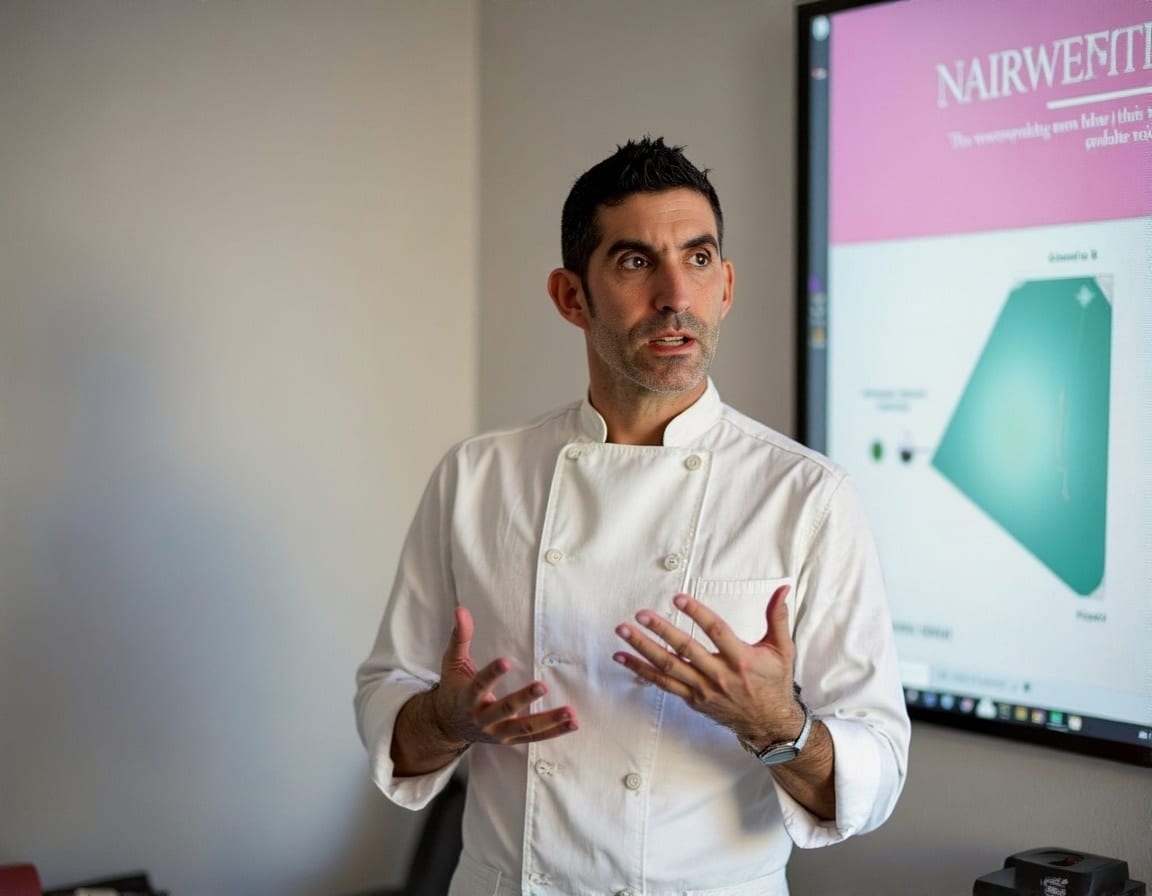 Thomas Albert is a pastry consultant, menu development consultant and trainer specialising in high-end pastry, alternative formulations and operational production management. He works with prestigious culinary institutions (Le Cordon Bleu, Ecole Ducasse, Culinary Art Academy Switzerland, La Folie Douce) and international hotel groups. More information at thomasalbert.fr.
Methodological references: menu engineering matrix (Kasavana & Smith, Michigan State University, 1982), consolidated practice in pastry consulting for 15 years.

